


WINEMAKER'S NOTES
Icewine is no longer a novelty, it’s now coveted (and expensive)
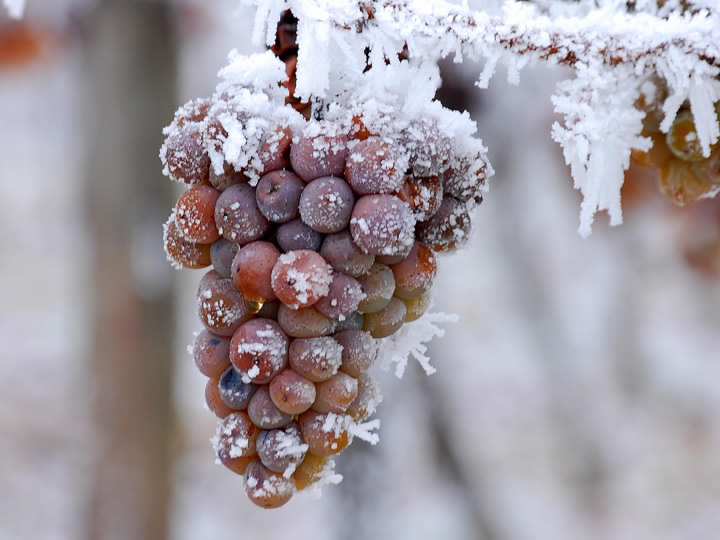
Icewine’s roots are firmly German. The first documented Eiswein harvest occurred in 1794, in Franconia, when an early frost forced growers to press frozen grapes. (Folklore has it the first harvest happened because the baron came back from war for Christmas and discovered the peasants hadn’t picked the grapes. The peasants offered a defense — no one had told them to. The Baron asked them to harvest what was available. As it was very cold by then, the first ice wine was the result.)
The technique of harvesting grapes at minus 7C, roughly 19 degrees Fahrenheit, and often colder, and pressing while frozen, concentrates sugars, acids and aromatics, as water remains ice.

By the 19th – 20th centuries, Eiswein became an elite specialty in regions such as Rheingau, Mosel, Pfalz, and Franken, commonly using Riesling grapes. Germany’s regulatory framework (later codified) set strict standards that defined Eiswein as a distinct, high-purity category rather than a late-harvest substitute.
In a normal year, the harvest window is about 15th of December until the middle of January. In Canada, where I make icewine, the VQA — Vinters Quality Alliance — regulates the harvest temperature as minus 8 Celsius and the grapes must be “naturally frozen on the vine”.
The main yield is around 10 to 15% of the normal harvest, which is what makes it so expensive (as well as the netting required to protect the vines, mostly from birds).
The first icewine in Canada was made in the Okanogan Valley, by a German immigrant as a very small experiment.

On Niagara-on-the-Lake, Inniskillin Wines was founded in 1975 by myself and Karl Kaiser. Inspired by German Eiswein and confident in Niagara’s winters, we pursued true icewine despite years of setbacks. For example, in December 1983, in attempting the first harvest having left some vines unharvested so we could produce icewine, a half a metre of snow had fallen and all of the seeds and berries that were covered by snow, and all of a sudden birds ravaged the vineyard and literally ate 13 rows right in the front driveway at the winery. That’s when we learned you had to put netting on, otherwise you would never have a harvest.
The first commercially viable Canadian icewine was made at Inniskillin from Vidal Blanc, a hardy hybrid well-suited to deep freezes and rot resistance. In 1991, Inniskillin’s 1989 Vidal Icewine won the Grand Prix d’Honneur at Vinexpo in Bordeaux, and shortly afterwards received the Gran Premio at VinItaly in Italy. This vaulted Canadian icewine onto the world stage.
Following Inniskillin’s success, icewine spread across Ontario and later British Columbia (back to the Okanagan Valley!) Canada established some of the world’s strictest rules and a winery has to file an application to make ice wine, and is charged $1000, which is used to hire inspectors, who we call the “ice Wine police”, to ensure all the regulations are enforced.

We transformed icewine from a rare European curiosity into a global luxury brand with Canada now the world’s most consistent producer. We always recognize the blessing we have in Canada, which psychologically resonates with consumers (especially the Japanese and Asian markets) because Canada has pristine mountains and is usually ice cold. Germany does not produce ice wine every year and, particularly, climate change makes it difficult.
Vidal Blanc is the prominent grape for ice wine, along with Riesling, and Cabernet Franc for red icewine, which is also very good. The VQA is Canada’s appellation system for authentic wine, emulating the OAC in France and the DOC in Italy. It certifies wines as 100% Canadian-grown, truthfully labeled by origin, grape variety, and vintage, and produced to defined quality and winemaking standards, and is legally embedded in provincial law and administered independently from wineries and operates through two provincial authorities, Ontario and British Columbia.
Before VQA, Canadian shelves were crowded with wines labeled “Cellared in Canada” or similar terms — often blends of imported bulk wine with minimal Canadian content. This confused customers.
For a number of years myself and the industry have formulated a plan for a national VQA Canada, to actually emulate the European Appellations such as the AOC in France and the DOC in Italy.

I literally wrote the book on ice wine! And with the compliments of WONDERUST and myself, you can obtain an electronic complementary copy. Scan the QR code (password: Vidal — add to the Discount box) and receive a copy of my book Ice wine: Extreme Winemaking, which will tell you everything you ever needed to know about the wine. There’s also a section on food pairings, with recipes by our then resident chef, Isabel Kalabos.
Since 2007, I have been producing Ziraldo Riesling and Vidal icewines, under my own label. And I have a son named Aspen, who is now 13 years old and has a great palette!
SCAN QR CODE FOR FREE BOOK


